Designing Future Engineers
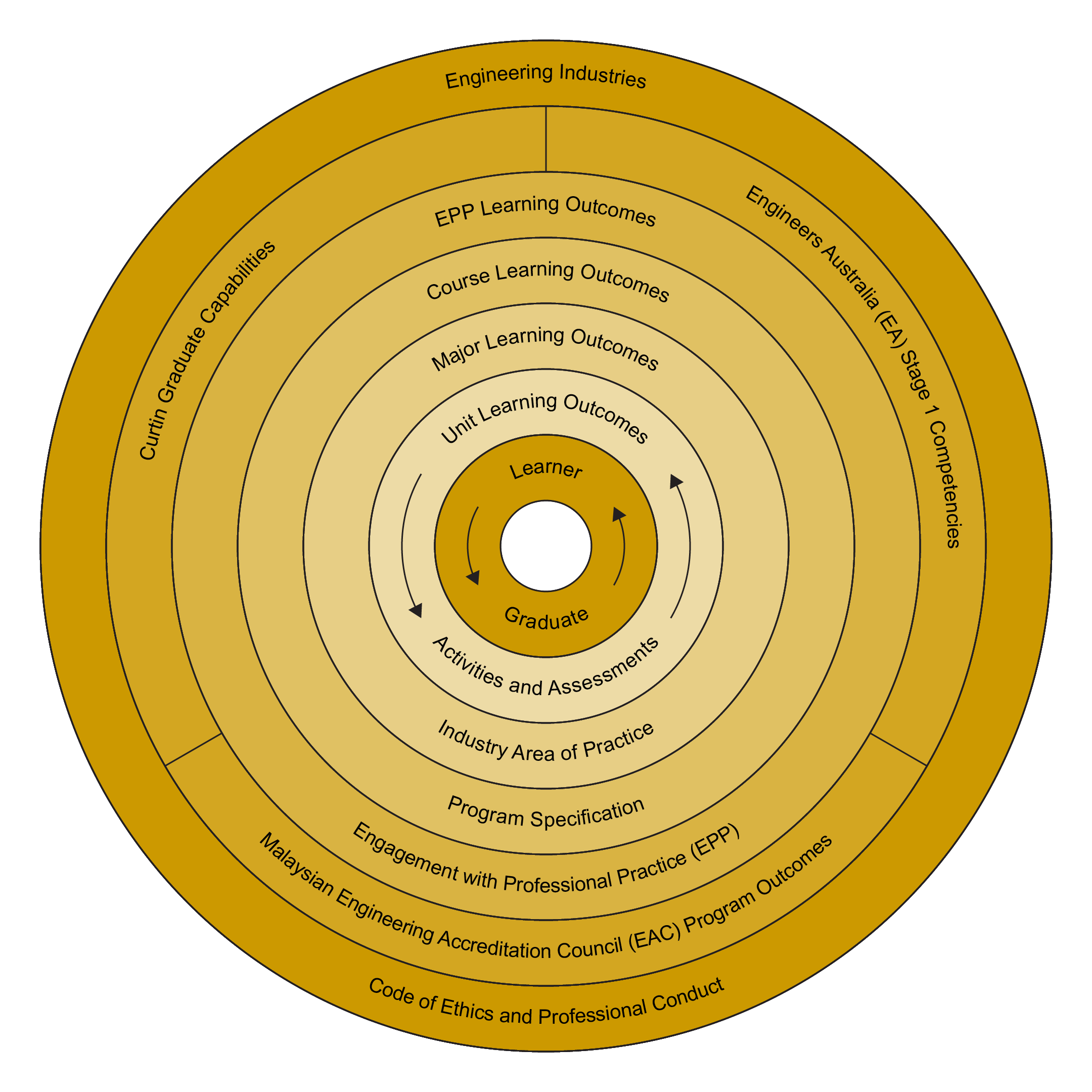
Your engineering course has been designed to ensure YOU are at the centre of the learning process. As a Learner at Curtin University, you will have teaching and learning opportunities through the curriculum, and responsibility to engage in seeking your own opportunities outside the curriculum, to meet completion requirements and become a Graduate.
Whilst as a learner you are probably most focussed on the Unit Learning Outcomes (ULOs). ULOs are the building blocks of a course. ULOs describe the expected achievement in every unit. Unit assessments and learning and teaching activities all align with ULOs. Your unit outline and My Course Map describe the activities and assessments for each unit and how they contribute to your development.
Completion requirements include demonstrating the learning outcomes in units and learning outcomes of engagement with professional practice. But learning doesn’t stop after you are a Graduate. For an engineering career you need to be a lifelong learner, developing knowledge and skills, to practice competently. Practicing competently, exercising leadership, demonstrating integrity and promoting sustainability are elements of the Engineering Code of Ethics and Guidelines of Practice This code is integral to the design of your course and you’re your work in engineering industries.
Curtin’s engineering courses develop Curtin Graduate Capabilities (GCs) and globally transferrable Engineering Competencies. Curtin Graduate Capabilities are the defining characteristics of all Curtin graduates. Curtin graduates acquire discipline knowledge and professional capabilities that enable them to transform lives and communities for the better.
The transferable engineering competencies are Course Learning Outcomes that describe the attributes of graduates – what they will be able to do and be. They are the condensed program specification.
Curtin has uniquely developed CLOs for Engineering that synthesise criteria from the Curtin Graduate Capabilities, Engineers Australia (EA) Stage 1 Competencies and Board of Malaysian Engineering Accreditation Council Programme Outcomes. EA Stage 1 Competencies are the profession’s expression of the knowledge and skill base, engineering application abilities, and professional skills, values and attitudes that must be demonstrated at the point of entry to practice.
Major Learning Outcomes (MLOs) define the discipline-specific attributes of graduates in a particular field of engineering, or field of engineering and the dual discipline in a double-degree (Commerce, Innovation, Science). MLOs are developed by incorporating the skills and knowledge of different industry areas of practice of engineering. This information comes from engineering industries and Engineers Australia, and Curtin’s ongoing engagement with industry through Industry Advisory Groups, research and teaching, and academics’ links with industry.
The building blocks of your course:
- Pre Major 200 Credits– The engineering foundation year prepares you for any discipline
- Major 500 credits– The main discipline of engineering you choose to study from 2nd year onward. This defines your core identity as an engineer.
- Options 100 credits – You have space for Options There are over 40 different minors and specialisations to choose from- scan the QR code
- Specialisation – A focus engineering area within your major OR a multi-disciplinary or different discipline focus.
- SPUE Extension Specialisation It lets you go deeper into a niche, advanced or emerging field within your discipline.
- SPUC Complementary Specialisation It lets you go broader than your discipline to explore other disciplines or a mixture of disciplines.
- Minor MINU – A secondary area of study outside your major and possibly outside of engineering. It broadens your skills and knowledge and can even be fully flexible electives from across the University (MINU-ENGFL).
- Specialisation – A focus engineering area within your major OR a multi-disciplinary or different discipline focus.
Professional engineering competencies
1. Knowledge and skill base
1.1: Comprehensive, theory-based understanding of the underpinning natural and physical sciences and the engineering fundamentals applicable to the engineering discipline
- GC1: Apply discipline knowledge, principles and concepts
- GC3: Effective communicators with digital competency
1.2: Conceptual understanding of the mathematics, numerical analysis, statistics, and computer and information sciences which underpin the engineering discipline
- GC1: Apply discipline knowledge, principles and concepts
- GC3: Effective communicators with digital competency
1.3: In-depth understanding of specialist bodies of knowledge within the engineering discipline
- GC1: Apply discipline knowledge, principles and concepts
- GC3: Effective communicators with digital competency
- GC6: Industry connected and career capable
1.4: Discernment of knowledge development and research directions within the engineering discipline
- GC2: Innovative, creative and entrepreneurial
- GC4: Globally engaged and responsive
- GC6: Industry connected and career capable
1.5: Knowledge of engineering design practice and contextual factors impacting the engineering discipline
- GC4: Globally engaged and responsive
- GC5: Culturally competent to engage respectfully with local First Peoples and other diverse cultures
- GC6: Industry connected and career capable
1.6: Understanding of the scope, principles, norms, accountabilities and bounds of sustainable engineering practice in the specific discipline
- GC1: Apply discipline knowledge, principles and concepts
- GC4: Globally engaged and responsive
- GC6: Industry connected and career capable
2. Engineering application ability
2.1: Application of established engineering methods to complex engineering problem solving
- GC1: Apply discipline knowledge, principles and concepts
- GC2: Innovative, creative and entrepreneurial
- GC6: Industry connected and career capable
2.2: Fluent application of engineering techniques, tools and resources
- GC1: Apply discipline knowledge, principles and concepts
- GC3: Effective communicators with digital competency
- GC6: Industry connected and career capable
2.3: Application of systematic engineering synthesis and design processes
- GC1: Apply discipline knowledge, principles and concepts
- GC2: Innovative, creative and entrepreneurial
- GC6: Industry connected and career capable
2.4: Application of systematic approaches to the conduct and management of engineering projects
- GC1: Apply discipline knowledge, principles and concepts
- GC4: Globally engaged and responsive
- GC6: Industry connected and career capable
3. Professional and personal attributes
3.1: Ethical conduct and professional accountability
- GC4: Globally engaged and responsive
- GC5: Culturally competent to engage respectfully with local First Peoples and other diverse cultures
- GC6: Industry connected and career capable
3.2: Effective oral and written communication in professional and lay domains
- GC3: Effective communicators with digital competency
- GC6: Industry connected and career capable
3.3: Creative, innovative and pro-active demeanour
- GC2: Innovative, creative and entrepreneurial
- GC4: Globally engaged and responsive
3.4: Professional use and management of information
- GC3: Effective communicators with digital competency
- GC6: Industry connected and career capable
3.5: Orderly management of self and professional conduct
- GC1: Apply discipline knowledge, principles and concepts
- GC4: Globally engaged and responsive
- GC6: Industry connected and career capable
3.6: Effective team membership and team leadership
- GC1: Apply discipline knowledge, principles and concepts
- GC5: Culturally competent to engage respectfully with local First Peoples and other diverse cultures
- GC6: Industry connected and career capable
My Course Map is a tool to identify and track the development of competencies to support your reflective practice throughout your course. It presents the integrated and comprehensive mapping of Units to Course Learning Outcomes, Graduate Attributes (Curtin Graduate Capabilities) and Accreditation Standards (Engineers Australia Stage 1 Competencies). My Course Map displays important themes threaded throughout your course such as integrated engagement with professional practice and, personal and professional skills.
Some simplifications are made for the pre-major – not all alternative cores are shown- nor are Options listed.
MATH1017 and MATH1018: These units are designed for those students who have passed WACE Mathematics Specialist ATAR and may be chosen at student’s’ discretion.
*CHEM1003: Students who have not successfully completed ATAR Chemistry or equivalent must enrol to this option.
*PHYS1006: Students who have not successfully completed ATAR Physics or equivalent must enrol to this option.
*All students to choose alternate core unit COMP1005. Students completing MJRH-SFTEN, select COMP1007. If you are completing a double degree with Science, refer to the Handbook for guidance.
Please consult the online courses handbook for updated information and course availability. The online handbook is the repository of Curtin University’s course information. For detailed course overviews and enrolment information please visit curtin.edu.au/study. Unit outlines for units you are enrolled in are displayed on OASIS under the My Studies tab one week before the study period commences. Please refer to your Unit Outlines and Curtin Handbook for current and official versions of course and units.